
The Invisible Shield: How Quality Management Impacts Product Safety
Posted by Oscar Combs in Blog, Home Page
23
Jan
2026
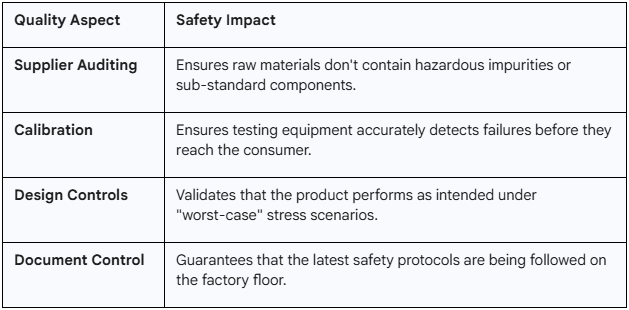
To the end-user, “quality” often feels like a luxury—a smoother finish, a faster processor, or more durable stitching. However, in high-stakes industries like medical devices, automotive, and food production, quality is the thin line between a functioning product and a catastrophic safety failure. While quality focuses on meeting requirements, safety focuses on the absence of unacceptable risk. The two are inextricably linked: you cannot have a safe product without a high-quality process behind it. Most product safety incidents aren’t caused by a single “bad day” on the assembly line. They are the result of systemic “latent conditions”—small, undetected quality lapses that align to create a disaster. This is often illustrated by the Swiss Cheese Model of accident causation. In this model, each layer of your Quality Management System (QMS)—such as supplier vetting, equipment calibration, and final inspection—acts as a slice of cheese. While every slice has “holes” (potential weaknesses), a robust quality system ensures these holes do not align, blocking the path to a safety hazard. A commitment to quality impacts safety through three primary mechanisms: …….Quality systems require rigorous documentation. If a specific batch of raw …….materials is found to be contaminated, a high-quality system allows the company …….to pinpoint exactly which units are affected. Without this, a small issue …….necessitates a massive, slow, and dangerous “scorched earth” recall. …….Safety is often a byproduct of predictability. When a process is “in control,” the …….product is identical every time. Inconsistency (poor quality) introduces variables …….that might lead to a structural weakness in a car frame or an incorrect dosage in a …….pharmaceutical pill. …….When a defect occurs, a quality-driven organization doesn’t just “fix it and move …….on.” They use RCA to understand why it happened. This prevents the “near-miss” …….of today from becoming the “fatality” of tomorrow. For the end-user, the quality of a product isn’t just about satisfaction; it’s about trust. When an organization compromises on a “minor” quality standard to save time or cost, they are effectively gambling with the user’s well-being. True quality management transforms safety from a reactive “fingers-crossed” hope into a proactive, engineered certainty. In the eyes of the consumer, the highest form of quality is the product they never have to worry about. Oscar Combs is the President of The ISO 9001 Group, a consulting, auditing and training company headquartered in Houston, Texas. With over 31 years of experience in the field, he is recognized as an expert in the implementation of management systems that help organizations manage risk and improve operational efficiency. The ISO 9001 Group is a business and management systems consulting, auditing and training firm headquartered in Houston, Texas with 5 regional resources in Atlanta, Chicago, Denver, New York, and Portland. Contact us at info@iso9001group.com for more information or www.iso9001group.com. Click here to watch on YouTube.
The Anatomy of a Safety Failure
How Quality Safeguards the Consumer
…..• Traceability and Accountability:
…..• Process Consistency:
…..• Root Cause Analysis (RCA):
Quality vs. Safety: The Interdependency
The Moral Mandate of Quality
About The Author
The ISO 9001 Group
Watch on YouTube
Contact Us Today