

The Comfort in Chaos: Navigating the Cultural Resistance to ISO 9001
Posted by Oscar Combs in Blog, Home Page
16
Jan
2026
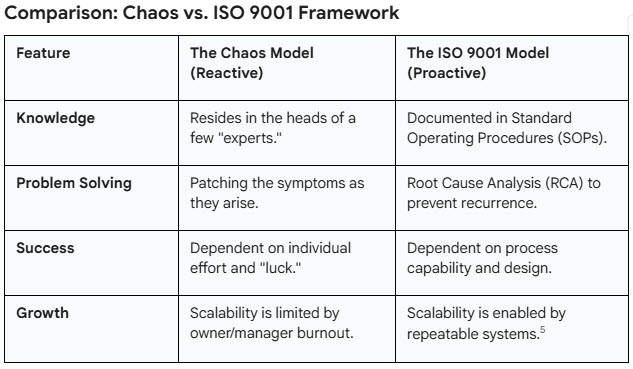
In the corporate world, there is a pervasive paradox: organizations frequently invest significant capital and man-hours into achieving ISO 9001 certification, only to subconsciously sabotage the system once it is in place. While the standard is designed to streamline operations and ensure quality, it often encounters a formidable opponent—the “comfort of chaos.”1 To understand why organizations resist this positive change, we must look beyond the technicalities of auditing and into the psychological and structural foundations of workplace culture. In many chaotic organizations, status is derived from crisis management. When a process is ill-defined, things inevitably break. The individual who steps in to “save the day” receives immediate validation, gratitude, and visibility. ISO 9001 thrives on the mundane. It prioritizes repeatability and prevention over dramatic intervention. For a workforce conditioned to thrive on the adrenaline of firefighting, a functional Quality Management System (QMS) can feel like it is “stripping away the soul” of the work. When things go right every time because the process is robust, there are no heroes—only efficient operators. Systems theory suggests that organizations, like biological organisms, seek homeostasis—a stable state of being. If an organization has operated in a state of “organized chaos” for a period of time, that mess becomes its baseline. Implementation of ISO 9001 represents a “system shock.” Resistance often manifests as: …..• Malicious Compliance: Doing the bare minimum to pass an audit while maintaining old, inefficient habits. …..• Information Siloing: Resisting the ISO requirement for transparency because “knowledge is power” in a disorganized environment. A core pillar of ISO 9001 is Evidence-Based Decision Making. This requires data, metrics, and the tracking of Non-Conformances (NCRs). In a chaotic culture, ambiguity is a shield; if there are no clear metrics, it is difficult to pinpoint failure. By introducing a QMS, an organization forces a mirror in front of its leadership. The system reveals exactly where the bottlenecks are and who is responsible for them. For many, the “chaos” was a convenient veil for incompetence or inefficiency that ISO 9001 ruthlessly removes. For ISO 9001 to move from a “necessary evil” to a driver of positive change, leadership must reframe the narrative. …..• From Policing to Empowering: Shift the focus of audits from “finding mistakes” to “identifying friction.” …..• Rewarding Prevention: Instead of praising the person who fixed the late shipment, publicly reward the team that identified a process flaw that would have caused a delay. …..• Simplification: Resistance often stems from over-complicated documentation. A lean, visual QMS is much harder to resist than a 400-page manual of dense prose. The resistance to ISO 9001 is rarely about the standard itself; it is about the fear of losing the familiar, even when the familiar is dysfunctional. To move toward true quality, an organization must be willing to trade the “highs” of chaotic success for the sustainable, predictable growth of a disciplined system. Oscar Combs is the President of The ISO 9001 Group, a consulting, auditing, and training company headquartered in Houston, Texas. With over 31 years of experience in the field, he is recognized as an expert in the implementation of management systems that help organizations manage risk and improve operational efficiency. The ISO 9001 Group is a business and management systems consulting, auditing and training firm headquartered in Houston, Texas, with 5 regional resources in Atlanta, Chicago, Denver, New York, and Portland. Contact us at info@iso9001group.com for more information or www.iso9001group.com. Click here to watch on YouTube.
1. The Addictive Quality of “Hero Culture”
2. Organizational Homeostasis
3. The Transparency Trap
4. Overcoming the Resistance
Conclusion
About The Author
The ISO 9001 Group
Watch on YouTube
Contact Us Today